

Is Rutgers Under the Influence?

By Ann Tomoko Rosen
Since it’s $1 billion deal with RWJ Barnabus in 2018, Rutgers has become something of a clinical trial factory.
This appears to be by design. Academic health care systems and public-private partnerships are changing the practice of medicine – and not necessarily in a good way. According to the Daily Targum, RWJ invested an initial $100 million “to fund the partnership’s educational and research missions” with the promise of an additional $1 billion over the next twenty years.
What does a partnership like this mean to Rutgers? Here’s Rutgers Biomedical and Health Sciences Chancellor Brian Strom describing the benefits of this arrangement:
RWJ Barnabas has committed to a $1 billion investment over the next 20 years in facilities and services. Ostrowsky couldn’t say exactly where or how the bricks and mortar side of the deal will happen, but Rutgers Biomedical and Health Sciences Chancellor Brian Strom said the added capacity of Barnabas will have an impact on the bottom line by helping the new entity get a larger slice of grants and clinical studies.
“We can go to contract for research with pharma and NIH [National Institutes of Health] and other agencies, saying we have this huge population we can bring, a very diverse population, a major strength that New Jersey has to be able to bring to these clinical trials, [and] with that bring additional revenue,” noted Strom. (emphasis mine)
https://www.njspotlightnews.org/video/rutgers-rwj-barnabas-consummate-deal-for-large-academic-health-system/
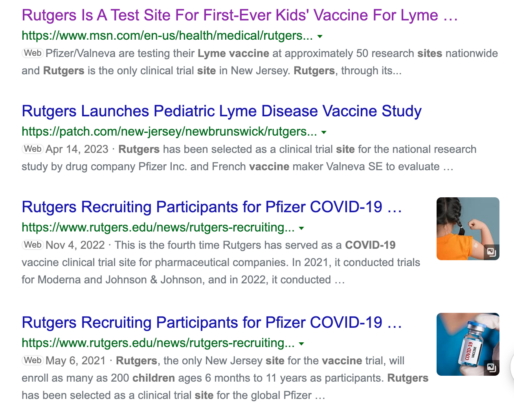
If research contracts are the goal, the university can claim success. Rutgers now boasts a new state-of-the-art facility, which has hosted COVID-19 vaccine clinical trials by Johnson & Johnson, Moderna and Pfizer, including pediatric vaccine clinical trials for children 6 months to 4 years. And it is now enrolling children (part of the “huge population” they can bring) for a clinical trial for a Lyme disease vaccine being developed by Pfizer and French vaccine maker Valneva.
But should research contracts be the goal?
“A Force for Change”
As Rutgers Biomedical Health Sciences (RBHS) spokesperson Neal Buccino explains, “The Rutgers-RWJBarnabas Health partnership brings together two higher education and healthcare leaders to create the largest academic health system in New Jersey — one that will fundamentally change healthcare in New Jersey and beyond.”
Buccino called the partnership “a force for change and innovation, shaping the future of the healthcare delivery system.”
When an institution says it plans to fundamentally change healthcare, it’s important to pay attention to how it goes about impacting change.
Consider Rutgers’ efforts to drive COVID policy since that time:
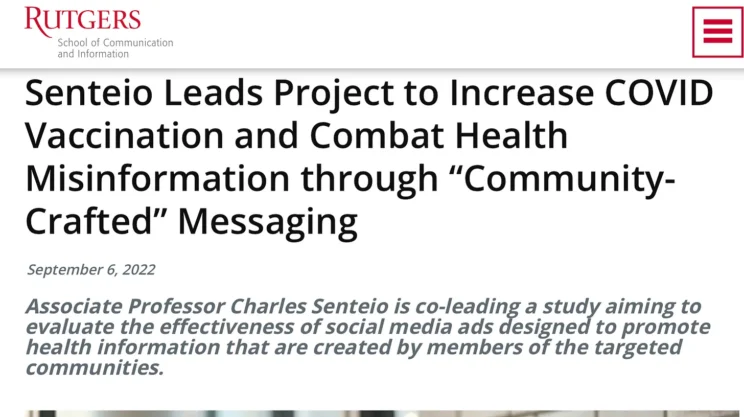
Rutgers University is a member of The Mercury Project, a consortium of researchers working to build vaccine demand and support “science-based health decision making.” Specifically, behavioral science-based. Among Mercury Project sponsors are the Bill and Melinda Gates Foundation, the Robert Wood Johnson Foundation and The Rockefeller Foundation. Thanks to funding from the Social Science Research Council (SSRC) Mercury Project, Rutgers is participating in research to apply social and behavioral science “to combat the growing global threat posed by low Covid-19 vaccination rates and public health mis- and disinformation.”
Missing the Forest for the Trees
Covid vaccine mandates are not an effective public health measure. Available shots were formulated for variants that no longer exist and do not work against the COVID strains currently in circulation. These shots do not stop infection or transmission and any protection they offer is limited and short-lived. The high rate of breakthrough infections and increasing rate COVID hospitalizations among the vaccinated provide mounting evidence of the failure of public health policies based on mass vaccination for COVID.
An unprecedented number of student athletes have collapsed on playing fields and experienced cardiac events since the rollout of these shots. Young people continue to “die suddenly” at rates never seen before (do quick search on anything but Google).
Anyone who takes the time to look can find the information at this point. The problem seems to be that that no one will fund those efforts at Rutgers or any other academic health care system. But, until they are willing to acknowledge the inconvenient science, do we really want to trust the minds and bodies of the future to these institutions?