

The Trouble with Health Equity

Earlier this month, Kaitlan Baston, New Jersey’s new acting commissioner of the Department of Health, was introduced at a Public Health Council meeting. Baston is stepping in following the retirement of former commissioner Judy Persichilli, who was responsible for much of New Jersey’s COVID pandemic policy. In addition to greeting her new colleagues and going over her bio, Baston gave the now obligatory nod to “health equity”.
But what is health equity?
According to the CDC,
Health equity is the state in which everyone has a fair and just opportunity to attain their highest level of health. Achieving this requires ongoing societal efforts to:
- Address historical and contemporary injustices;
- Overcome economic, social, and other obstacles to health and health care; and
- Eliminate preventable health disparities. [1,2]
To achieve health equity, we must change the systems and policies that have resulted in the generational injustices that give rise to racial and ethnic health disparities.
Before we all hop on the equity bandwagon, we have to decide whether we even want what public health is offering. Because free garbage is still garbage. And ultimately we’re all paying for it.
Unfortunately, much of the current application of “health equity” is geared towards roping populations who have historically been subject to “generational injustices” into the flawed system that was built from those injustices and continues to expose everyone to harm.
Public health entities are now pouring millions into messaging campaigns in every language designed to regain the trust of the same communities that were first exploited as test subjects. But given the legitimacy of their mistrust, this is largely a gaslighting campaign.
And equal access to one-size-fits-all protocols does not mean equal distribution of harm. The most important ethnic health disparities are still not being addressed.
Consider what Mayo Clicic vaccinologist Gregory Poland discovered back in 2014.
The most outstanding and, to some degree, unexpected difference that we found is that African Americans have much higher antibody responses to this viral vaccine, Rubella, than we have seen in any other population…
We sort of have a population level approach to medicine. We do it with drugs, we do it with vaccines. We assume everybody’s alike, as if they all respond the same…Our group has been among the first to show that what we know for how people to respond to drugs turns out to also be true for how people respond to biologics like vaccines. So you and I may respond very differently as a cohort of Caucasians, but my colleague who’s African American, and the population of African Americans, turn out to have a much better response to that vaccine. Hispanics have a lower response.
Well this is really important in how we deliver vaccines, how we design vaccines… perhaps the safety of vaccines. And this is new information in the biologic field that I think is going to change how we practice medicine. A vaccine in essence is working differently. The question is why the same vaccine in human beings administered the same way, and yet it stimulates a very different set of gene expression and protein secretion – that protein being antibody that protects us when we see the virus.
…the interesting thought occurs to me – maybe we only need to give African Americans half the size dose that we give to Caucasians. That’s an example of individualizing our approach to somebody.
…So we may be able to save cost. We may be able to reduce the amount of side effects. If you only need half as much vaccine to reach the same level of protection, we’re adding cost and potentially risk by giving you double what you actually need…
… If we see these kinds of dramatic differences with this vaccine, will we see it with another vaccine? The answer is “Yes”. We’ve seen that with other vaccines.
…This study demonstrates the important differences that one can find and informs how we approach the medical care of those groups. (emphasis mine)
So we learned in 2014 that African-Americans have a much higher antibody response to vaccines, which poses potential risks. But we did not change vaccines or adjust dosages in the name of health equity, even as autism rates soared among Somalian refugees and the Somalian community observed links to the MMR vaccine.
Instead we turned to behavioral science and messaging.
And the campaign that attempts to build trust without earning it continues…

Incidentally, only after Dr. Poland experienced his own vaccine injury did he redirect his energy towards revisiting potential side effects. Sadly, this is what “inclusion” in the medical paradigm really looks like for many who participate.
Racial Disparities and HPV Vaccines
We saw similar disparities with the HPV vaccine, which covered strains that primarily impacted white women.
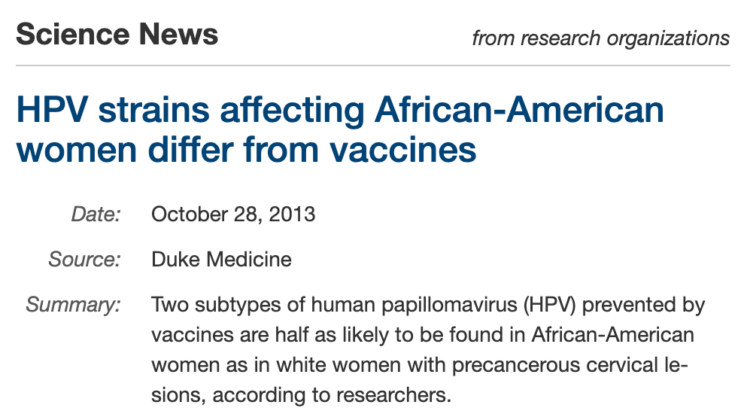
The study acknowledged that even the “new and improved” Gardasil 9 vaccine fails to cover the most common strains affecting African-American women (even as it subjects recipients to significant risk of serious adverse events).
A new HPV vaccine targeting nine HPV subtypes (6, 11, 16, 18, 31, 33, 45, 52 and 58) is currently being tested in phase III trials. While the new vaccine may help prevent additional HPV infections by covering new subtypes, it may not address the disparities found in this study.
“The most disconcerting part of this new vaccine is it doesn’t include HPV 35, 66 and 68, three of the strains of HPV of which African-American women are getting the most,” Hoyo said. “We may want to rethink how we develop these vaccines, given that African-Americans tend to be underrepresented in clinical trials.”
And still no proof that any of these shots prevent cancer in anyone.
Yet, messaging campaigns continue in pursuit of vaccine acceptance.
Provider recommendations and accurate distribution of information must be increased and targeted to racial/ethnic minority populations in order to bolster the rate of vaccine uptake. To effectively target these communities, multi-level interventions need to be established.
Inclusion in BigPharma’s Most Profitable Experiment
Inclusion and equity under BigPharma-sponsored public health programs make us ALL test subjects. We are ALL part of the experiment now.
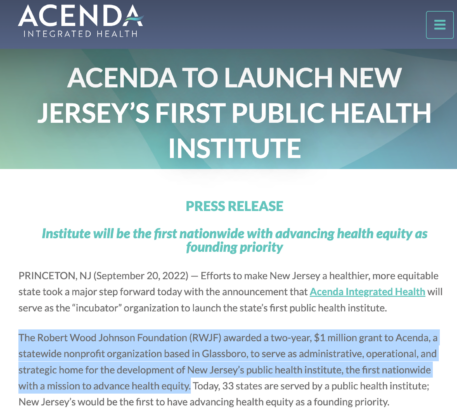
Health equity is public health’s tailored propaganda campaign. And we’re about to see even more of it in New Jersey thanks to a $1 million grant from ACENDA and the creating of NJ’s new Public Health Institute.
Please. Think twice before you allow public health to make it up to you for past injustices. We first need to introduce public health accountability.
What we’re begin offered isn’t healthy.